
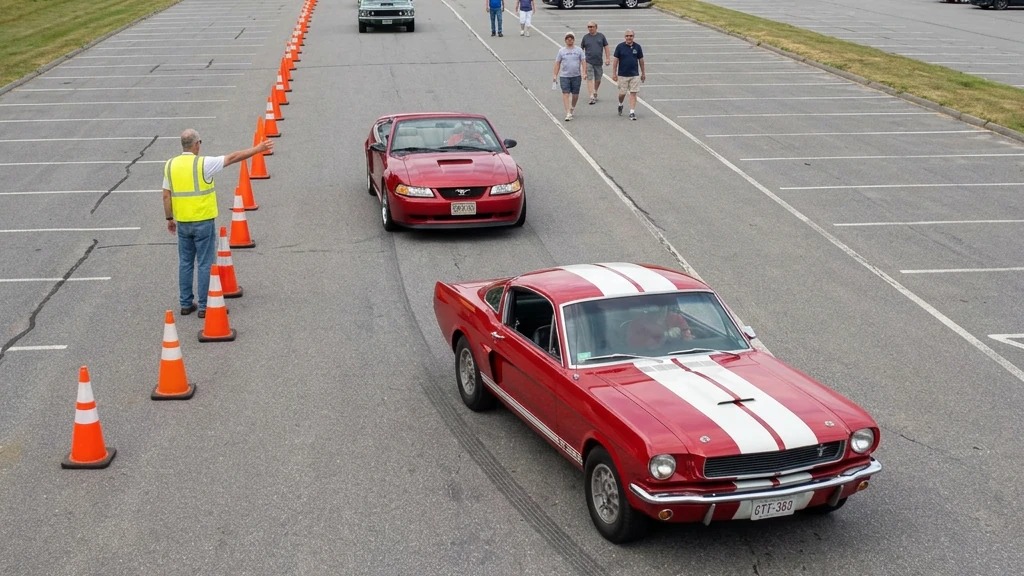
A calm show field begins before the first hood is raised. The useful plan is not a longer rule sheet; it is a visible route that tells each driver where to slow, where to wait and where people can walk without crossing an incoming line of cars.
When a club show backs up, the problem often starts at the entrance. One driver stops to ask where a class is parked, a trailer reaches the unloading area at the same time as the display cars, and spectators begin walking through the only open lane. The result is a queue on the road and too many decisions being made through open windows.
The FHWA planned-special-event traffic checklist treats route planning, site access, parking, pedestrian access and traffic control as connected parts of one plan. A Mustang club does not need a highway command center to use that idea. It needs a one-page field map, a few clearly assigned arrival windows and volunteers who all give the same short direction.
The map is the first volunteer briefing
Start the field map at the public road, not at the show rows. Mark the gate where a car can safely pause without blocking through traffic. Then draw a continuous path to registration, the judged display rows, trailer unloading, spectator parking and the exit. If a driver must reverse or cross an incoming lane to reach a destination, the layout still has a conflict to solve.
The same map should reserve an emergency lane and show where pedestrians move after they park. Accessible spaces and their access aisles are not overflow areas or convenient places for cones and supplies. ADA.gov's accessible-parking guide explains that accessible spaces need a usable access aisle and a short accessible route to the entrance or activity. The venue owner and local authorities should confirm the final layout and any permit or fire-access requirements before the club publishes arrival instructions.
A useful map fits on one screen and one printed page. Use names that can be spoken from a car window: “registration lane,” “trailer hold,” “display row A” and “spectator walk.” Matching those names on the map, cones and volunteer notes reduces the improvised gestures that make a busy entrance harder to read.
Arrival windows give each car a predictable path
Different vehicles need different amounts of time and space. Mixing them at one opening time makes every volunteer solve the hardest case at once. A simple sequence can separate the work without turning the day into a rigid timetable.
| Arrival window | Who uses it | What the gate volunteer confirms |
|---|---|---|
| Early setup | Trailers, vendors and field crew | Unloading path is open, tow vehicles have a destination and the emergency lane stays clear. |
| Display arrival | Judged and club cars | Registration is ready, the correct row is accepting cars and walking traffic is held away from the lane. |
| Public opening | Late display cars and spectators | The main show rows are closed to unnecessary movement and overflow directions are visible before the gate. |
The club can also reduce gate delays before anyone leaves home. Ask entrants to arrive with the confirmation email or class information easy to reach, not buried in the trunk. A brief vehicle reminder is useful too. NHTSA's driving guidance recommends checking for open recalls, using the pressure shown by the vehicle maker rather than the maximum on the tire, inspecting tire condition and carrying basic roadside supplies. Those are road-trip checks, not judging rules, but they help keep an avoidable breakdown out of the arrival lane.
Each volunteer should own one decision. The person at the road identifies the correct lane. The registration team confirms the entrant. A row marshal places the car. When one person tries to perform all three jobs, the line stops every time a question reaches beyond the gate.
A walking test finds conflicts a windshield misses
Before opening, one volunteer should drive the route at walking speed while another follows the pedestrian path. The test should include a long car, a vehicle approaching the accessible area and a trailer entering and leaving the unloading zone. Watch for a cone hidden by a hood, a turn that requires a second attempt, a sign that becomes unreadable in the queue and any place where people naturally step into the vehicle line.
The FHWA pedestrian-access chapter recommends minimizing conflicts between walking routes and parking access points and using volunteers inside parking areas to help keep vehicle and pedestrian movements separate. For a club show, that can be as practical as moving the check-in table away from the lane, opening a continuous walkway behind the display rows and waiting to release the next Mustang until the previous driver and passenger are clear.
Finish the test at the exit. A route that works only for arrival can fail after an award ceremony when many cars leave together. The exit volunteer needs a clear sight line, the pedestrian path must remain visible, and no display row should depend on another row moving first. Record any change on the same map used at the gate so every volunteer is working from the final layout.
A successful arrival plan is easy to recognize: the road stays clear, directions take one sentence, entrants reach the right row without reversing through the crowd and spectators know where to walk. That quiet first hour gives the Mustangs—and the people who brought them—the attention the show was built for.